
ERPNext for Manufacturing: 7 Clear Signs Your Factory Needs an Upgrade Today
Introduction
ERPNext for Manufacturing is becoming the preferred choice for manufacturers looking to improve productivity, reduce operational inefficiencies, and gain complete visibility into their business processes.
If you’re managing production through spreadsheets, maintaining inventory manually, or struggling to coordinate between procurement, production, quality, and dispatch teams, your factory may have already outgrown its current systems.
Many manufacturers continue to rely on disconnected software, paper-based records, and manual reporting. While these methods may work initially, they often create bottlenecks as the business grows. Delayed production schedules, inventory inaccuracies, quality issues, and poor decision-making are common symptoms of outdated processes.
ERPNext for Manufacturing provides a single integrated platform that connects inventory, production planning, procurement, quality management, maintenance, sales, and finance. Instead of operating with fragmented information, every department works from the same real-time data.
Whether you operate an auto-component manufacturing unit, an engineering company, a chemical plant, an FMCG production facility, or a fabrication workshop, ERPNext for Manufacturing can help streamline operations and support sustainable growth.
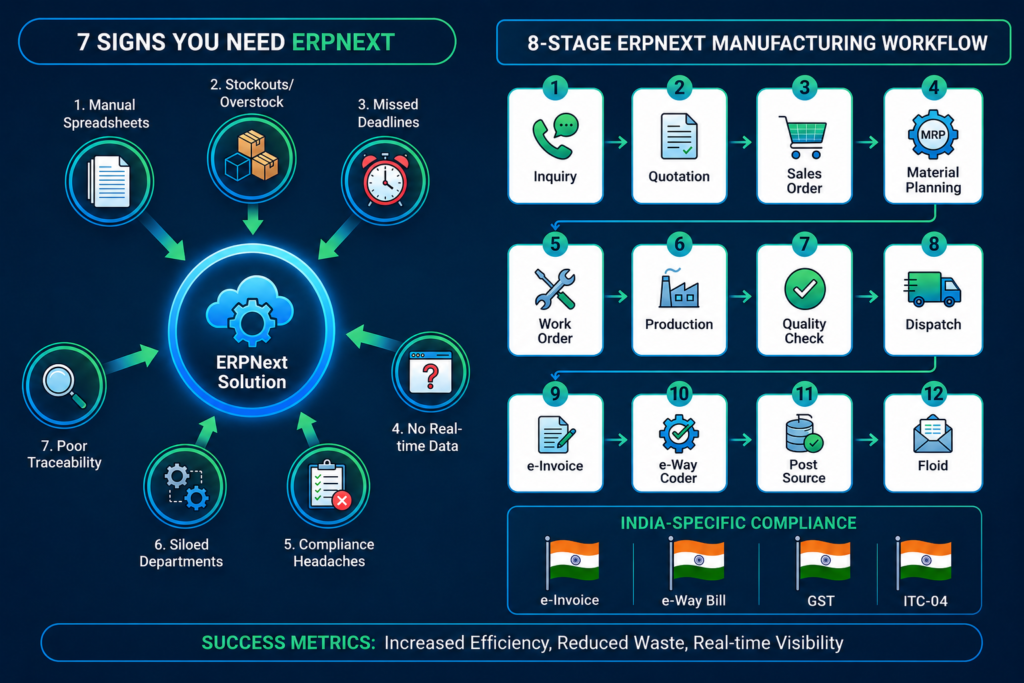
In this article, we’ll discuss seven important signs that indicate your factory is ready for ERPNext and what steps you should take next.
ERPNext for Manufacturing Sign #1: Your Team Depends on Multiple Excel Sheets
Spreadsheets are useful for small operations, but they quickly become difficult to manage when production volumes increase. Different departments often maintain separate files, resulting in duplicate entries, version-control issues, and reporting delays.
When critical business decisions depend on manually updated spreadsheets, the risk of errors increases significantly.
How ERPNext for Manufacturing Helps
ERPNext centralizes all operational data in a single system. Production, inventory, purchasing, and sales information are updated in real time, reducing manual work and improving accuracy.
ERPNext for Manufacturing Sign #2: Inventory Problems Are Hurting Production
Inventory is one of the largest investments in any manufacturing business. Poor inventory management often results in either stock shortages or excess inventory.
Stock shortages cause production delays, while excess inventory increases storage costs and locks up working capital.
How ERPNext for Manufacturing Helps
ERPNext provides real-time inventory visibility, automated reorder levels, Material Requirement Planning (MRP), and batch tracking to ensure materials are available when needed.
ERPNext for Manufacturing Sign #3: Production Planning Is Becoming More Difficult
As order volumes increase, production planning becomes increasingly complex. Manual scheduling methods often lead to missed deadlines, machine idle time, and inefficient resource utilization.
How ERPNext for Manufacturing Helps
ERPNext enables structured production planning through Bills of Materials (BOMs), Work Orders, Production Plans, and Capacity Planning tools.
ERPNext for Manufacturing Sign #4: Product Traceability Is Limited
Many industries require complete traceability of raw materials, work-in-progress items, and finished goods. Without proper traceability, investigating quality issues becomes time-consuming and expensive.
How ERPNext for Manufacturing Helps
ERPNext supports batch-wise and serial number tracking, allowing manufacturers to trace products throughout the entire production lifecycle.
ERPNext for Manufacturing Sign #5: Management Lacks Real-Time Business Visibility
Many business owners spend hours gathering information from different departments before making decisions.
When reports are delayed, management often reacts to problems instead of preventing them.
How ERPNext for Manufacturing Helps
ERPNext provides dashboards and reports that deliver real-time insights into production, inventory, purchasing, sales, and financial performance.
ERPNext for Manufacturing Sign #6: Quality Issues Are Increasing
Quality problems directly impact customer satisfaction, profitability, and brand reputation.
Without standardized quality procedures, defects can reach customers before being identified.
How ERPNext for Manufacturing Helps
ERPNext includes quality inspections, inspection templates, rejection tracking, and quality reports that help maintain consistent product standards.
ERPNext for Manufacturing Sign #7: Your Current Software Cannot Support Growth
Many manufacturers use separate applications for accounting, inventory management, customer management, and production tracking.
As the business expands, disconnected systems create inefficiencies and data silos.
How ERPNext for Manufacturing Helps
ERPNext integrates all major business functions into one platform, making it easier to scale operations without increasing complexity.
Why Manufacturers Are Choosing ERPNext for Manufacturing
Manufacturers across industries are adopting ERPNext because it offers:
- Real-time operational visibility
- Improved inventory control
- Better production planning
- Stronger quality management
- Complete traceability
- Reduced manual work
- Lower software costs
- Scalability for future growth
Frequently Asked Questions About ERPNext for Manufacturing
What is ERPNext for Manufacturing?
ERPNext for Manufacturing is a comprehensive ERP solution designed to help manufacturers manage production, inventory, procurement, quality control, maintenance, and accounting from a single platform.
Is ERPNext suitable for small manufacturing companies?
Yes. ERPNext for Manufacturing is highly suitable for MSMEs because it offers enterprise-level functionality without the high licensing costs associated with traditional ERP systems.
Can ERPNext manage production planning?
Yes. ERPNext includes production planning tools such as BOM management, Work Orders, Production Plans, and Capacity Planning.
How does ERPNext improve inventory management?
ERPNext provides real-time inventory tracking, automated replenishment, batch management, and Material Requirement Planning capabilities.
What Should You Do Next?
If your factory is experiencing three or more of the challenges discussed above, it may be time to evaluate a modern ERP platform.
ERPNext for Manufacturing can help reduce operational inefficiencies, improve visibility, strengthen quality control, and support long-term business growth.
At Exacuer Global Services, we specialize in ERPNext implementation, customization, training, and support for manufacturing companies across India and globally.
Contact us today to learn how ERPNext can transform your manufacturing operations.