ERPNext vs Odoo 2026: Which ERP Should Your Business Choose?
Choosing an ERP system is one of the most important technology investments a business can make. The right ERP not only streamlines operations but also influences productivity, scalability, operational costs, and long-term digital transformation.
When comparing ERPNext vs Odoo in 2026, the decision is less about choosing the “better” software and more about selecting the ERP philosophy that aligns with your business goals.
Both platforms offer comprehensive business management capabilities, including CRM, Sales, Inventory, Manufacturing, Accounting, HR, Purchasing, Projects, and Reporting. However, they differ significantly in licensing, architecture, customization approach, implementation costs, and long-term ownership.
This guide compares ERPNext and Odoo across the factors that matter most to growing businesses, including:
● Licensing Model
● Total Cost of Ownership (TCO)
● Manufacturing Capabilities
● Customization
● Scalability
● User Experience
● Upgrade Process
● Ecosystem
● Data Ownership
● Best Business Fit
Whether you’re a manufacturer, distributor, retailer, or service provider, this comparison will help you make a more informed ERP investment.
1. The Core Economic Difference: ERPNext vs Odoo Licensing
When evaluating ERPNext vs Odoo in 2026, the most significant factor influencing the Total Cost of Ownership (TCO) is not the user interface, features, or implementation methodology-it is the licensing model. The licensing approach determines how much your organization will spend over the lifetime of the ERP system and directly impacts scalability, budgeting, and long-term return on investment.
Businesses often focus on the initial implementation cost, but ERP software is typically used for 5–10 years or more. During this period, recurring licensing expenses can become one of the largest operational costs. This is where ERPNext and Odoo follow fundamentally different philosophies.
ERPNext: 100% Open Source with No Licensing Costs
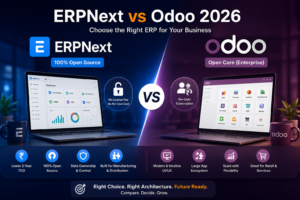
ERPNext vs Odoo in 2026
ERPNext is built on the GPLv3 open-source license, meaning the entire source code is freely available without feature restrictions. Unlike many ERP platforms, there is no separation between Community and Enterprise editions. Every organization receives access to the complete ERP system from day one.
Whether you choose to self-host on your own infrastructure or use a managed cloud hosting provider, you have access to all standard modules without paying recurring software license fees.
Key benefits include:
● No per-user licensing costs, regardless of company size.
● No hidden enterprise-only modules.
● Complete access to Accounting, CRM, Sales, Purchase, Inventory, Manufacturing, HRMS, Payroll, Projects, Quality, Asset Management, Maintenance, Support, and more.
● Freedom to customize the software according to your business processes.
● Full ownership of your business data and application code.
● Predictable long-term costs focused on implementation, support, hosting, and optional custom development rather than software subscriptions.
This licensing model is especially beneficial for manufacturing companies, distributors, exporters, and rapidly growing organizations, where the number of employees and ERP users increases over time. Companies can add departments, warehouse staff, finance teams, production supervisors, and management users without worrying about additional software licensing expenses.
Odoo: Open Core with Enterprise Licensing
Odoo follows an Open Core business model. While the Community Edition is available free of charge, it provides only a subset of the complete platform. Many advanced business capabilities are reserved for the Enterprise Edition, which requires an ongoing subscription.
Organizations requiring a full-featured ERP generally choose Odoo Enterprise because it includes advanced functionality, additional applications, official support, and enterprise services. However, this comes with per-user, per-month licensing fees, meaning software costs increase as the organization grows.
In many implementations, businesses also need to consider additional costs for:
● Enterprise user licenses
● Premium applications
● Hosting
● Implementation services
● Customization
● Annual maintenance and support
As employee counts increase, licensing expenses continue to rise, making budgeting more complex for organizations with expanding teams.
Why This Difference Matters
The licensing philosophy has a direct impact on long-term ERP economics.
With ERPNext, organizations primarily invest in implementation quality, process optimization, training, and business improvements, rather than recurring software licenses. Once implemented, companies can continue expanding their operations without incurring additional per-user ERP licensing costs.
With Odoo Enterprise, software licensing becomes an ongoing operational expense. While the platform offers a polished interface and extensive ecosystem, organizations should account for recurring subscription costs throughout the ERP lifecycle.
For businesses planning long-term digital transformation, especially those expecting workforce growth, multiple departments, or expanding manufacturing operations, understanding this licensing difference is critical. It affects not only the initial investment but also the overall Total Cost of Ownership (TCO), scalability, and financial sustainability over the years.
Ultimately, the choice depends on your organization’s priorities. If minimizing recurring licensing costs and maintaining complete control over your ERP platform are key objectives, ERPNext offers a compelling open-source model. If your business values Odoo’s enterprise ecosystem and is comfortable with subscription-based licensing, Odoo Enterprise may align better with your strategy.
2. 3-Year TCO Comparison (50-User Scenario)
While Odoo often appears cheaper at the “start” due to low-cost entry points, these costs stack aggressively as you scale.
| Cost Item (3-Year Est.) | ERPNext | Odoo Enterprise |
| Software License | ₹0 | ₹18–27 Lakh |
| Implementation | ₹4–7 Lakh | ₹5–12 Lakh |
| Hosting | ₹5–11 Lakh | ₹5–11 Lakh |
| AMC / Support | ₹3–7.5 Lakh | ₹6–12 Lakh |
| 3-Year TCO | ₹12–25.5 Lakh | ₹34–62 Lakh |
Note: Figures are estimates based on mid-market deployments in the Indian market.
3. Hidden Customization and Upgrade Costs
One of the most critical factors in TCO is Upgradeability.
ERPNext (The Monolith): Because ERPNext is a monolithic, tightly integrated system, updates are generally more stable and the upgrade path is clearly defined by the Frappe Framework. Customizations are contained within separate Frappe apps, which typically upgrade cleanly.
Odoo (The Modular Ecosystem): Odoo’s strength is its massive marketplace of third-party apps. However, this leads to “Dependency Hell,” where custom modules or third-party apps break during version upgrades. This necessitates ongoing maintenance and developer intervention, which can significantly escalate long-term TCO.
4. ERPNext vs Odoo: Which ERP Is Best for Your Business?
Choose ERPNext if:
● You prioritize license cost predictability and want zero per-user fees.
● You are in manufacturing or distribution and need a “one-size-fits-all” robust system out of the box.
● You value data ownership and a fully open-source philosophy.
● You have access to in-house Python/Frappe development capacity.
Choose Odoo if:
● User Adoption & UX are your highest priorities; the interface is modern and consumer-grade.
● You need a vast ecosystem of pre-built integrations (e.g., specific shipping, e-commerce, or marketing platforms) that you don’t want to build yourself.
● You operate in a retail or professional services industry where Odoo’s modular “pay-as-you-grow” model fits your scale.
Need an expert audit of your current business processes? Contact Exacuer Global to discuss how we can help you choose the right architecture for your growth, ensuring you stay in control of your costs and your data.
For your Research : Read More