Introduction: The Story Begins at Exacuer of ERPNext
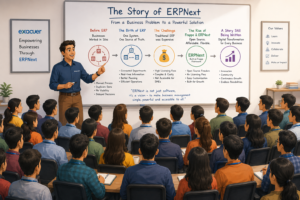
It was a typical Monday morning at Exacuer Global Services.
The office was buzzing with activity. Developers were discussing ERPNext customizations for manufacturing clients. Business Analysts were mapping workflows and identifying process improvements. The Sales team was engaging with prospective customers, while Project Managers monitored implementation milestones and the Accounts team reviewed financial transactions.
Like every day, there was one common thread connecting everyone in the organization – ERPNext.
Whether it was customer relationship management, inventory tracking, production planning, accounting, reporting, or workflow automation, ERPNext was at the center of almost every discussion.
For anyone walking into the office for the first time, one question would naturally arise:
Why has ERP become so important in modern business?
The answer lies in a story that began long before cloud computing, mobile applications, and digital transformation became business buzzwords.
The story of ERP is, at its core, the story of a problem businesses struggled with for decades.
Before ERP: When Businesses Worked in Silos
Several decades ago, businesses operated very differently from how they do today.
Customer orders were recorded manually.
Inventory was maintained in physical registers.
Purchase departments worked with separate records.
Production planning relied heavily on spreadsheets and paperwork.
Accounting teams maintained their own systems independently.
Every department performed its responsibilities efficiently, but very little information moved seamlessly across the organization.
As businesses expanded, these disconnected processes created significant challenges.
Common issues included:
• Inventory shortages causing production delays
• Excess inventory increasing carrying costs
• Delayed customer deliveries
• Duplicate data entry
• Slow reporting cycles
• Limited management visibility
Business leaders often spent more time gathering information than analyzing it.
Organizations needed a better way to connect people, processes, and information.
This need became the foundation for what would eventually become ERP.
The Birth of ERP
The first major step toward ERP came with Material Requirements Planning (MRP).
MRP systems helped manufacturers answer critical questions:
• What materials are required?
• How much inventory is needed?
• When should materials be purchased?
• How should production be planned?
For the first time, businesses could use technology to improve production planning and inventory management.
However, manufacturers soon realized that inventory was only one piece of the puzzle.
Businesses required a unified system capable of connecting every department.
This led to the evolution of Enterprise Resource Planning (ERP).
ERP introduced a revolutionary concept:
One Business. One System. One Source of Truth.
Instead of operating in isolation, departments could now share information through a common platform.
When a sales order was created, production could immediately view demand.
When production planned manufacturing activities, purchasing could arrange materials accordingly.
When products were shipped, accounting records could update automatically.
ERP transformed disconnected operations into connected business processes.
The Challenge with Traditional ERP Systems
By the 1990s and early 2000s, ERP systems had become an essential part of enterprise operations.
Organizations experienced several benefits:
✔ Improved visibility
✔ Faster decision-making
✔ Better resource planning
✔ Higher productivity
✔ Improved customer service
✔ Greater operational control
However, there was a significant limitation.
Traditional ERP solutions were often expensive and complex.
Businesses were required to invest heavily in:
Large enterprises could justify these investments.
Small and medium-sized businesses often could not.
As a result, many growing companies continued relying on spreadsheets and disconnected systems despite the operational challenges they created.
The ERP industry needed a more accessible solution.
The Rise of Frappe and ERPNext
This challenge inspired a new generation of business software.
Founded by Rushabh Mehta and developed by Frappe Technologies, ERPNext was built on a simple yet powerful vision:
Enterprise software should be accessible, flexible, and affordable for businesses of all sizes.
Rather than following the traditional ERP model, ERPNext embraced open-source technology.
Built on the Frappe Framework, ERPNext was designed to provide enterprise-grade functionality without the barriers commonly associated with traditional ERP systems.
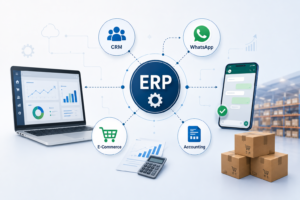
ERPNext combines multiple business functions into a single platform, including:
This unified approach allows organizations to manage their operations through a single source of truth.
Why ERPNext Became a Global Success
One of the key reasons behind ERPNext’s rapid global adoption is its open-source philosophy.
Unlike many traditional ERP platforms, ERPNext does not force businesses into expensive licensing models.
Open Source Means Freedom
ERPNext gives organizations the freedom to:
• Access source code
• Customize workflows
• Build integrations
• Extend functionality
• Adapt processes according to business requirements
This flexibility enables organizations to implement software that supports their operations rather than forcing operations to adapt to software limitations.
No Licensing Fees
Perhaps one of ERPNext’s most attractive advantages is the absence of traditional software licensing fees.
Many ERP vendors charge businesses based on the number of users.
As organizations grow, software costs increase significantly.
ERPNext follows a different philosophy.
Businesses can expand their teams, onboard new users, and scale operations without worrying about escalating licensing expenses.
This significantly lowers the total cost of ownership and makes ERP technology accessible to growing organizations.
Built for Growth
ERPNext offers three major advantages for modern businesses:
Cost Efficiency
Enterprise-level capabilities without enterprise-level licensing costs.
Flexibility
Workflows can be adapted to suit industry-specific requirements.
Scalability
Organizations can grow without needing to replace their ERP system.
These factors have helped ERPNext become one of the most respected open-source ERP platforms in the world.
The Strength of the Frappe Ecosystem
ERPNext’s success extends beyond software.
It is supported by a global ecosystem of developers, consultants, implementation partners, and business users.
The Frappe community continuously contributes improvements, innovations, integrations, and new features.
This collaborative approach accelerates innovation while ensuring ERPNext remains relevant to evolving business needs.
Today, thousands of organizations across manufacturing, trading, distribution, services, education, healthcare, and other industries rely on ERPNext to manage their operations.
Exacuer’s Role in the ERPNext Journey
At Exacuer Global Services, we believe technology should solve business problems, not create complexity.
As an ERPNext implementation and consulting partner, our focus extends beyond software deployment.
We work closely with organizations to understand:
- Business processes
- Operational challenges
- Growth objectives
- Reporting requirements
- Automation opportunities
Using ERPNext and the Frappe Framework, we help businesses:
For us, ERP implementation is not about installing software.
It is about enabling sustainable business growth.
Why ERPNext Matters More Than Ever
Today’s businesses operate in an environment where speed, accuracy, and visibility determine success.
Customers expect faster service.
Management teams require real-time insights.
Markets change rapidly.
Organizations can no longer depend on spreadsheets, disconnected systems, and manual processes.
They need:
✔ Real-time visibility
✔ Process automation
✔ Accurate reporting
✔ Scalability
✔ Data-driven decision-making
This is precisely where ERPNext delivers value.
ERPNext has evolved beyond traditional ERP software and become a platform that enables organizations to compete, grow, and innovate.
A Story Still Being Written
The story of ERP is ultimately the story of business evolution.
From paper-based records and spreadsheets to cloud-based business management platforms, organizations have continuously searched for better ways to manage information and improve operations.
ERPNext represents the next chapter of that journey.
Combining open-source innovation, flexibility, affordability, and enterprise-grade functionality, ERPNext has made digital transformation accessible to businesses of all sizes.
And through the combined efforts of the Frappe community, implementation partners, and forward-thinking organizations, that story continues to evolve every day.
In the next chapter of Exacuer Global Services our Manufacturing Diaries series, we will explore The ₹12 Lakh Inventory Mistake and examine how the right ERP processes can prevent costly operational errors while creating a stronger foundation for business growth.
Book a free ERPNext demo: