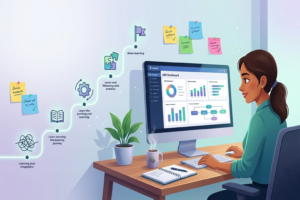
Starting my journey with ERPNext was both exciting and overwhelming. Like many beginners entering the ERP domain, I initially thought learning the software would simply mean understanding screens, modules, and features. However, as I started working on real projects and supporting customers, I realized ERP is much more than software — it is deeply connected to how businesses actually function.
My journey with ERPNext became a continuous learning experience filled with challenges, problem-solving, customer interactions, and practical business understanding. While working on ERPNext implementation and support projects at Exacuer Global Services, I gained valuable insights into how businesses manage operations, inventory, manufacturing, sales, and customer relationships through an integrated ERP system. Over time, the confusion slowly turned into confidence.
Understanding ERP Beyond the Software
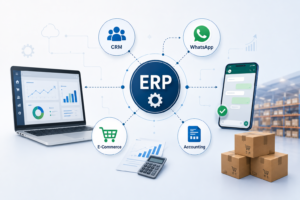
When I first started learning ERPNext, I was introduced to multiple modules such as CRM, Selling, Purchase, Stock, Manufacturing, and HRMS. At first, it felt difficult to understand how everything connected together.
As part of my learning journey at Exacuer Global Services, I quickly realized that ERPNext is much more than ERP software. It is a complete business management platform that helps organizations streamline operations, automate workflows, improve inventory management, and connect multiple departments through a single system.
For example, a simple sales process involved multiple interconnected stages, including lead and customer management, quotation creation, sales order processing, stock availability checks, product delivery, invoicing, and payment tracking. Understanding how these stages work together helped me realize that ERPNext is not just about individual modules but about managing an entire business process from start to finish.
Similarly, in manufacturing, understanding BOMs (Bill of Materials), Work Orders, production planning, and warehouse movement required not only software knowledge but also an understanding of real business operations.
Initially, I focused on learning features individually, but gradually I understood that ERP systems work as one connected ecosystem. A small mistake in stock entries, permissions, or workflows could impact multiple departments.
That realization completely changed the way I approached ERPNext.
Challenges I Faced During My Learning Journey
One of the biggest challenges was understanding customer-specific workflows. Every company operates differently, even when they belong to the same industry.
Some customers had complex warehouse structures, while others required custom approval workflows or specific pricing logic. Understanding their processes and translating them into ERPNext configurations was not always easy.
Working on real ERPNext support cases exposed me to a wide range of business scenarios. From inventory management challenges to workflow configuration requirements, every customer presented a unique opportunity to understand how ERP systems support day-to-day operations.
Another challenge was handling support issues and troubleshooting errors. Sometimes issues that looked very small on the surface took hours to properly understand and resolve.
Some of the most common challenges I encountered included incorrect stock balances, permission-related issues, data import errors, workflow confusion among users, report mismatches, and transaction errors during daily operations. While these issues often appeared simple at first glance, they frequently required careful investigation to identify the actual cause and implement the right solution.
In the beginning, these issues felt intimidating. But over time, I learned an important lesson: solving ERP problems is not just about fixing errors — it is about understanding the root cause behind them.
That mindset helped me become more analytical and patient while working on ERPNext support cases.
How Frappe Documentation Helped Me Grow
One of the most valuable learning resources during my ERPNext journey at Exacuer Global Services was the documentation provided by Frappe Technologies for ERPNext.
Whenever I got stuck while understanding a feature, troubleshooting an issue, or learning a workflow, the documentation became my first source of guidance.
What I found especially helpful was:
- Clear explanations of modules and features
- Step-by-step setup guidance
- Detailed workflow understanding
- Technical references for customization and APIs
- Community-driven learning resources
Instead of depending entirely on others for solutions, I started developing the habit of researching problems independently. This improved both my confidence and problem-solving abilities.
The documentation also taught me an important professional skill: learning how to learn.
In the ERP domain, every customer requirement can be different, so continuous learning becomes necessary. Having reliable documentation made that learning process much smoother.
Supporting Customers and Understanding Their Needs
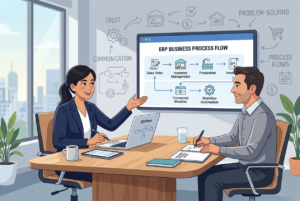
One of the most rewarding parts of working with ERPNext has been supporting customers directly.
Initially, I believed ERP support was mainly about solving tickets and fixing software issues. But with experience, I realized customers often need much more than technical assistance. They need someone who understands their operational challenges.
At Exacuer Global Services, customer support goes beyond resolving technical issues. It involves understanding business processes, identifying operational bottlenecks, and helping organizations get the maximum value from their ERPNext implementation.
Many times, users are not comfortable with ERP systems in the beginning because they are shifting from manual processes or older systems. In such situations, communication becomes just as important as technical knowledge.
I learned how important it is to listen carefully before suggesting solutions, understand the customer’s business pain points, ask the right questions, explain workflows in simple language, and help users adapt to new processes. These skills not only improved customer interactions but also helped build trust and confidence during ERPNext implementation and support activities.
Even small improvements in communication made a big difference in customer confidence and user adoption.
Over time, I also became more comfortable handling customer concerns, conducting discussions, and following up on unresolved issues. These experiences helped me improve not only technically but professionally as well.
Problem Solving: The Most Important Skill I Developed
ERP implementation and support constantly involve problem-solving.
There were situations where customers faced operational disruptions due to incorrect configurations, missing permissions, or process misunderstandings. Some problems required coordination between functional understanding and technical troubleshooting.
These experiences taught me the importance of approaching problems systematically. Instead of jumping directly to a solution, I learned to first understand the issue clearly, analyze its impact on business operations, reproduce the problem whenever possible, identify the root cause, test potential solutions carefully, and communicate progress and updates effectively to the customer. Following this structured approach helped me resolve issues more efficiently and minimize disruptions for users.
I learned that rushing toward solutions without understanding the actual problem often creates bigger complications.
Problem-solving in ERPNext also improved my analytical thinking. Instead of viewing issues as obstacles, I started seeing them as opportunities to understand the system more deeply.
Every resolved issue added to my confidence and practical knowledge.
Communication Skills and Professional Growth
Another major area of growth during my ERPNext journey has been communication.
Working with customers from different business backgrounds taught me how to explain technical concepts in a simple and understandable way. Not every user is familiar with ERP terminology, so clarity and patience become extremely important.
Whether supporting manufacturing companies, distribution businesses, or service organizations, effective communication played a critical role in successful ERPNext adoption, user training, and ongoing ERP support.
I also learned the importance of professional communication, active listening, managing customer expectations, providing clear and timely follow-ups, and collaborating effectively with team members. These skills played a crucial role in ensuring smooth customer interactions, reducing misunderstandings, and building stronger working relationships throughout ERPNext implementation and support projects.
Good communication often helps prevent confusion before it becomes a larger issue.
I realized that technical knowledge alone is not enough in ERP consulting or support roles. The ability to communicate effectively with customers, understand their concerns, and guide them through solutions is equally important.
From Confusion to Confidence
Looking back, my ERPNext learning journey at Exacuer Global Services has been filled with challenges, continuous learning, and practical experience supporting ERPNext implementations, troubleshooting business workflows, and helping customers optimize their operations through ERP technology.
What once felt confusing gradually became more familiar through hands-on work, customer interactions, troubleshooting, and self-learning. Each support ticket, workflow discussion, and resolved issue helped me grow more confident in my understanding of ERP systems and business processes.
ERPNext not only taught me software functionality but also helped me understand how businesses operate behind the scenes. It improved my analytical thinking, communication skills, and ability to solve real-world problems.
Most importantly, it taught me that growth comes through consistency, curiosity, and the willingness to learn from every challenge.
About Exacuer Global Services
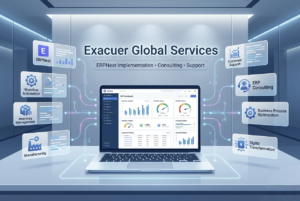
Exacuer Global Services helps businesses streamline operations through ERPNext implementation, ERP consulting, ERP customization, support services, workflow automation, and business process optimization. By leveraging the power of ERPNext, we help organizations improve operational efficiency, gain better visibility into their processes, and achieve sustainable business growth
Helpful Resources
Throughout my ERPNext learning journey, the following resources played an important role in helping me understand features, workflows, and best practices:
- ERPNext Documentation – https://docs.erpnext.com
- Frappe Framework Documentation – https://frappeframework.com/docs
- ERPNext Official Website – https://erpnext.com
These resources are excellent starting points for anyone looking to learn ERPNext, explore the Frappe Framework, or better understand ERP implementation and business process automation.