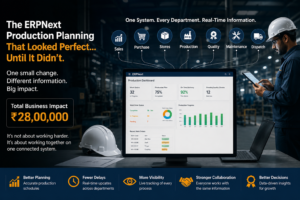
The ERPNext Production Planning That Looked Perfect… Until It Didn’t.
The Story Continues at Exacuer of ERPNext Production Planning.
After discussing the ₹12 lakh inventory mistake in our previous knowledge-sharing session, another interesting question came up from one of our team members.
The ERPNext Production Planning. That Looked Perfect Unitl It Didn’t
At first glance, the production planning process looked perfectly configured. Everything appeared to be working as expected—until a small oversight exposed a critical issue that could lead to inaccurate planning, material shortages, and production delays.
“Sir, if inventory is available, can production still fail?”
I smiled.
“Absolutely.”
Because sometimes, the problem isn’t inventory.
It’s planning.
Many manufacturers believe that once raw materials are available, production will automatically run smoothly. But in reality, production depends on much more than inventory. It requires every department to work together, with the same information, at the same time.
That’s exactly what happened at Apex Components.
Everything Was Ready… Or So They Thought
After overcoming their inventory challenges, Apex Components was finally confident.
Raw materials were in stock.
Customer orders had been confirmed.
Machines were available.
The production team prepared a detailed production plan, supervisors assigned manpower, and the sales team confidently committed delivery dates to customers.
Everything looked perfect.
The factory started production exactly as planned.
For the first few days, everything seemed to be running smoothly.
Then, one unexpected event changed everything.
One Small Change… A Chain Reaction
A critical production machine suddenly required emergency maintenance.
The team immediately shifted the job to another machine.
But that machine was already allocated to another customer order.
Production priorities changed.
Unfortunately, nobody informed every department.
Sales still believed the original delivery date was achievable.
Production was waiting for machine availability.
Quality was waiting for completed batches.
Dispatch had no idea when finished goods would actually be ready.
Every employee was working hard.
Every department was doing its job.
But everyone was working with different information.
And that’s when the production plan began to fail.
The ₹28 Lakh Impact
Determined to avoid disappointing their customer, the company did everything possible to recover.
Extra shifts were introduced.
Part of the production was outsourced.
Premium freight services were booked to reduce delays.
The customer eventually received the order.
But the business paid a heavy price.
Total Business Impact: ₹28,00,000
The loss wasn’t caused by a lack of inventory.
It wasn’t caused by inefficient employees.
It happened because there was no single system connecting every department.
The Turning Point: ERPNext Production Planning
After reviewing the entire incident, Apex Components realized something important.
The factory didn’t need people to work harder.
It needed everyone to work together.
The company implemented ERPNext Manufacturing, connecting every department through one integrated ERP system.
Suddenly, information started flowing automatically.
- Sales could check real-time production progress before committing delivery dates.
- Production Managers planned and monitored Production Plans and Work Orders from a single dashboard.
- Stores automatically reserved raw materials for scheduled production.
- Purchase received alerts before material shortages became production delays.
- Maintenance scheduled machine servicing without disrupting production.
- Quality tracked inspections as part of the manufacturing process.
- Dispatch knew exactly when finished goods were ready to ship.
- Management could monitor the entire factory in real time.
Every employee-from the Store Executive and Production Supervisor to the Sales Team, Quality Inspector, Purchase Manager, and Factory Head-worked on the same ERPNext system.
When one employee updated the system, everyone who needed that information could see it instantly.
No phone calls.
No separate Excel sheets.
No confusion.
Just one source truth for the entire organization.
The Lesson for Every Manufacturer
Many manufacturers think production planning is simply creating a schedule.
In reality, production planning is about coordination.
Even the best production plan can fail when Sales, Purchase, Stores, Production, Quality, Maintenance, and Dispatch operate independently.
A modern manufacturing business needs more than experienced employees.
It needs every employee to work with the same real-time information.
That’s exactly what ERPNext Manufacturing delivers.
By connecting every department into one integrated platform, ERPNext improves production planning, reduces delays, increases visibility, and helps manufacturers make better decisions every day.
Because in manufacturing, success isn’t just about working hard. It’s about working together on one connected system.
To Be Continued…
As the discussion ended, another team member raised one final question.
“Sir… what happens when production is completed on time, but the customer still doesn’t receive the order?”
I smiled.
Because that story isn’t about production.
It’s about logistics, dispatch, and how one delayed shipment can damage years of customer trust.
Next Episode
The Shipment That Left the Factory… But Never Reached the Customer on Time.
Stay tuned… because every manufacturing challenge has a lesson, and every lesson has a solution.