The Tyranny of Proprietary ERP and the Liberation That Followed
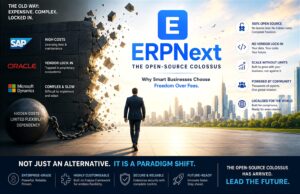
In an era dominated by exorbitantly priced enterprise software behemoths, such as SAP, Oracle, and Microsoft Dynamics, which demand not merely financial tribute but an almost ecclesiastical devotion to their proprietary ecosystems, a formidable challenger has emerged from the open source realm. ERPNext open source ERP, built atop the elegant Frappe framework, is not merely an alternative; it is, for the discerning enterprise, an unequivocal paradigm shift. It democratises operational sophistication and renders the prohibitive cost of digital transformation not just manageable but frankly unnecessary.
For decades, businesses, particularly small and mid sized enterprises, have been held hostage by licensing models so convoluted that they require dedicated consultants merely to decipher the invoice. Proprietary ERP systems arrive with golden promises but depart with institutional dependencies so entrenched that switching costs alone become a strategic deterrent. Vendor lock in is not a bug in this model; it is rather the defining feature.
ERPNext open source ERP ruptures this paradigm with surgical precision. As a fully open source solution licensed under the GNU General Public License (GPL), it places the entire source code, unredacted and unencumbered, in the hands of the enterprise. There are no hidden modules lurking behind paywalls, no feature tiers calibrated to extract maximum revenue, and no artificial ceilings imposed on growth. The software evolves with your business, not against it.
The Extraordinary Economics of Open Source
The financial arithmetic here is, to put it mildly, staggering. Traditional ERP implementations routinely demand six to seven figure investments before a single invoice is generated or a solitary inventory entry is logged. Licensing fees, implementation charges, annual maintenance contracts, and the perpetual parade of “mandatory upgrades” collectively constitute what industry analysts euphemistically term the “total cost of ownership.” This is a figure that, for mid market enterprises, can render digital transformation a luxury rather than a strategy.
ERPNext open source ERP obliterates this calculus entirely. The software itself is free. Implementation costs are dramatically reduced. And because the community continuously contributes enhancements, bug fixes, and localisation modules, enterprises benefit from a perpetual innovation engine that no single proprietary vendor, regardless of their research and development budget, can realistically replicate.
For a business operating in emerging markets, this is not merely advantageous; it is transformative.
Community as Competitive Advantage
Detractors of open source enterprise software frequently invoke the spectre of inadequate support, the notion that without a multinational corporation’s helpdesk, businesses are adrift in a sea of unresolved tickets. This argument, whatever its historical merit, collapses entirely upon examination of the ERPNext open source ERP ecosystem.
The Frappe community, comprising thousands of developers, implementers, and practitioners distributed across more than 150 countries, constitutes a support infrastructure of genuinely extraordinary depth. GitHub repositories teem with active contributions. Discussion forums address edge cases with a specificity that proprietary support channels rarely achieve. A global network of certified Frappe Partners, rigorously trained and officially recognised specialists, ensures that enterprises receive implementation expertise calibrated to their precise operational context.
This is not crowdsourced mediocrity; it is collective intelligence at industrial scale.
👉 Further Exploration- ( https://opensource.org/ )
👉 Related Insights- ( https://erpnext.com/ ) ( https://frappe.io/ )
Functionality That Demands Serious Attentionn
One might reasonably anticipate that an open source ERP carries functional compromises, meaning that the price of accessibility is a diluted feature set. ERPNext open source ERP emphatically dispels this assumption.
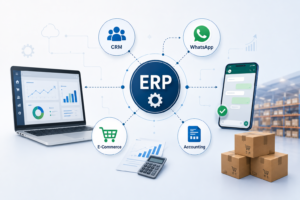
The platform encompasses an exhaustive suite of modules: financial accounting with multi currency and multi company support, procurement and supply chain management, manufacturing with bill of materials and production planning, human resources and payroll, customer relationship management, project management, ecommerce integration, and a remarkably sophisticated asset management framework. Each module is not a superficial implementation but a genuinely enterprise grade capability, refined through years of real world deployment across industries as diverse as healthcare, retail, education, and manufacturing.
The Frappe framework underlying ERPNext open source ERP further enables bespoke customisation without modifying core code through a metadata driven architecture that preserves upgradability while accommodating the idiosyncratic requirements of individual enterprises. This is software engineering philosophy elevated to strategic business advantage.
The Localisation Imperative
Global enterprises operate within jurisdictions of bewildering regulatory complexity, including GST frameworks, VAT structures, localised payroll compliance, and country specific chart of accounts conventions. Proprietary vendors, for all their resources, frequently lag in localisation; niche markets receive perfunctory attention while marquee geographies absorb disproportionate development investment.
ERPNext open source ERP inverts this dynamic entirely. Community contributors from every significant market have developed and continuously maintain localisation modules that addresses compliance requirements with a granularity that proprietary counterparts struggle to match. From Indian GST to UAE VAT to OHADA accounting standards, the platform’s global footprint is, quite simply, comprehensive.
The Strategic Verdict
The question confronting modern enterprises is no longer whether open source ERP is viable; that debate was conclusively settled years ago. The question, rather, is whether organisations possess the strategic clarity to recognise that ERPNext open source ERP represents not a compromise but a competitive advantage, not a budget option but an intelligent allocation of capital toward capabilities that scale, adapt, and evolve.
ERPNext open source ERP, in the hands of a certified Frappe Partner, is not merely software. It is infrastructure for ambition, a platform upon which enterprises can construct operational sophistication previously accessible only to corporations with IT budgets that dwarf the gross domestic product of small nations.
The Next Generation of Enterprise Software Won’t Be Proprietary
The era of expensive licensing models, rigid software ecosystems, and vendor dependency is steadily giving way to a more intelligent approach one built on openness, adaptability, and continuous innovation.
Organizations that adopt Open Source today are positioning themselves to move faster, innovate more effectively, and compete with greater confidence tomorrow. With ERPNext and the expertise of Exacuer Global Services, businesses can build a technology foundation designed not merely to support growth, but to accelerate it.
The question is no longer whether Open Source is the future. The question is whether your organization is prepared to benefit from it.
Our Website: (https://exacuer.com/)
Oue Servies: (https://exacuer.com/solutions/)
Book a free ERPNext demo: